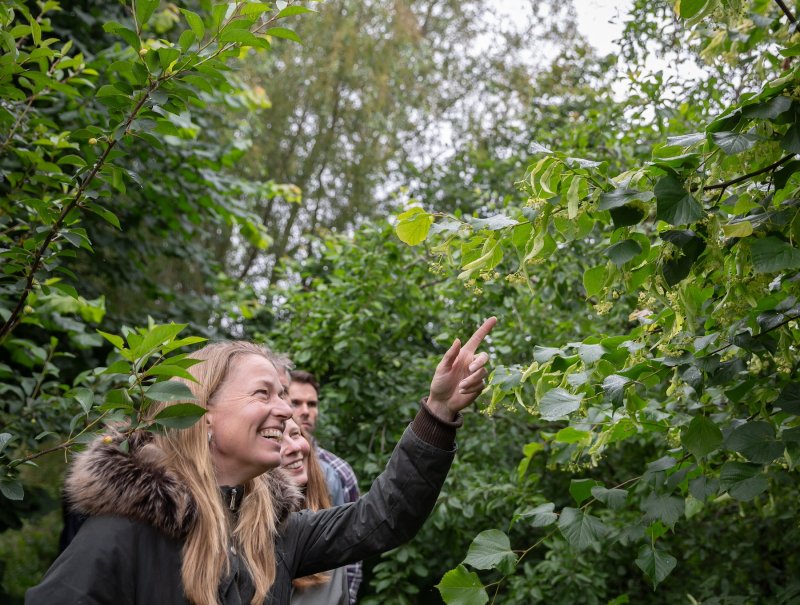
Create the design for your food forest
During this module you will work on your own plan. You will receive input and new theory from each instructor, which you should incorporate into your own plan immediately in the following days. You present your plan on the last day to lecturers and fellow students.

Design Module on five Wednesdays in May and June 2027
Dates: Wednesdays, May 12, May 19, June 2, June 9, June 30, 2027
Max. number of participants: 15
Instructors: Evelyn Derksen, Wide van der Kooij, and Wouter van Eck
Locations: Lydia Waterreus Food Forest in Zeewolde, “ Thuishaven ” Food Forest in Zeewolde, Ketelbroek Food Forest in Groesbeek, and we’ll wrap up at the Grootstal Estate in Nijmegen.
A successful food forest is always well designed. And we, in the food forest world, mean something quite different by design than, say, a graphic designer, or even a landscape designer. Yes, sightlines and functions and aesthetics are also important, but so is thinking in terms of time and harvestability. And how do you incorporate things like biodiversity and succession into your design? How do you avoid placing shrubs and trees too close together or too early in the wrong place? Or that there is just nothing for the wild bee to eat in one month?
The design module is a truly hands-on module. You’ll learn from three leading experts how to observe, think, and—above all—work like a designer. How do you think in terms of time, how do you translate functions into a plan, how do you incorporate ecology, and how do you develop a planting plan, etc.? You can also opt for an introductory course on the software that all professional designers use: Illustrator.
This module includes five days of in-person classes, plus the necessary self-study and assignments. If you want to get the most out of this module, it’s a good idea to set aside at least 4 hours—and preferably 8 hours—of self-study between classes. That way, you’ll get the most out of the course and the feedback you receive on your presentation.
May 12, Lydia Waterreus's Food Forest
Experienced food forest designer Evelyn Derksen lays a solid foundation for how to think like a designer. What do you need to have clearly defined in advance, what knowledge can you gather, and how do you manage your time? During this day, you’ll also take notes through drawing that you’ll carry with you throughout the rest of the design process. You’ll visit the first food forest she designed, Lydia Waterreus—which, funnily enough, started on sand and in a forest—and there you’ll experiment with environmental and site-specific factors. You’ll lay the practical foundation for your design.
May 19, Food Forest Thuishaven, Zeewolde
On the second day of the course, Wide will guide you further through the design process, and you’ll actively begin working on your food forest design. You’ll learn to translate information into layered sketches, gradually gaining a grasp of how to bring your ideas together in a clear drawing. On that day, we’ll visit another food forest in Flevoland: the Food Forest Thuishaven. It’s almost as old, but was established under completely different circumstances. There, you’ll also be able to see two hectares of standard production forest managed according to the methodology of the Dutch Food Forestry Foundation (Stichting Voedselbosbouw Nederland).
June 2, Ketelbroek Food Forest, Groesbeek
Wouter van Eck always says that the plants are like the towels in a newly designed bathroom. But by day three of the design module, we’re definitely ready for those super-cute towels! How do you get started? Where can you find the best cultivars? How do you narrow down this vast topic and lay out that basic grid that you can build on later?
Of course, this day wouldn't be complete without a visit to the beautiful Ketelbroek food forest.
June 9, Koperwiek Nursery, Hazerswoude Dorp
After spending a day with Wouter immersed in the world of plants, Evelyn will guide you back to your design, drawing on the knowledge you’ve gained. You’ll learn about plant arrangements, spacing, and combinations, among other things. We’ll do this at Kwekerij Koperwiek, where a dozen agroforestry systems have been designed and established, in part as teaching materials.
Everyone will sketch their own collection of planting systems for their food forest.
June 30, Grootstal Estate, Nijmegen
On this day, at the beautiful Grootstal Estate, we present our plans to each other and give feedback on form and content. We also reflect on how everyone's plan began and where it stands now.



Practical information about the annual training and modules
All class days, also the live days including the excursions are recorded. So if you cannot be there one time, or you were at the back of the group, you can always watch everything back.
We offer you from the start a digital course environment where you can find the course materials, the homework including all recordings, where you can easily ask questions among yourselves and/or make carpool appointments and where you can also store all your files.
The price for the design and food forest planning modules is €850 per module, excluding VAT. For these modules, we offer a discount of €35 per module if you are a member.
The price of the basic module is €600, excluding VAT. If you are a member of the Food from the Forest Association, we will immediately offer you a discount of €35.
If you take all the modules in the one-year training program, the price is €2,300.00, excluding VAT. For the one-year training program, we offer an immediate discount of €105 if you are a member of the Food from the Forest Association.
If you are a member and do not already see the discount in the tuition amount, please log in first!
We deliver this annual training according to our terms of delivery. These are simple and clear, so please read them.
If you are unable to pay the training fee at once, or if you work for an organisation that uses invoicing, please contact us.