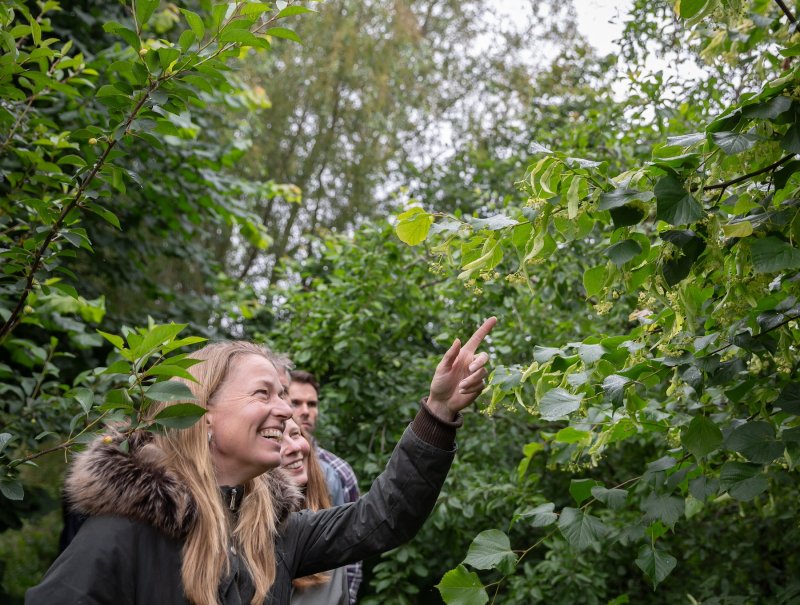
15 Class days, spread over the season, aimed at people who are serious about getting started with food forests
A food forest. It sounds very appealing. It's like paradise! Everywhere there is something tasty to snack on and it also grows without manure and without pesticides. Unfortunately, this attractive image often leads to the mistake that establishing a successful food forest is also very easy. You put down trees and nature does the rest. You don't have to do anything else.
This is both true and false. A successful food forest is not just planted, but built from a sound theory based on making nature's principles work for you as well as possible. And if you do that well, nature can then take over much of the usual work from you. But, how exactly does that work and what can you do right and wrong here?
In the complete year-long training you will learn not only what a successful food forest is ecologically, but also how to make a good design and food forest plan for this yourself. For example, you design in time, and so does the plan. How do you get through the first few years? What are the start-up costs? You will get lots of possible answers and also find them yourself during the course.
Let’s put it this way: A lot of people have already been able to turn their lives around. From a depressing office job to a way of life that truly helps restore nature and make our food healthier. As a food forest farmer, a food forest designer, a food forest manager, a chef, or a food processor. There are more and more possible revenue models associated with food forests.
If you take the full-year training, you’ll immerse yourself, as it were, in that dream, that step, or that opportunity for a whole year. And you won’t do it alone—you’ll do it together with the whole group.
This annual training is always on a Wednesday.
Basic Module on five Wednesdays in March and April 2027
Dates: Wednesdays, March 24, March 31, April 7, April 14, April 21, 2027
Max. number of participants: 20
Instructors: Wouter van Eck, Maarten Schrama, Marieke Karssen, and Martijn Aalbrecht
Locations: Ketelbroek Food Forest in Groesbeek (1 session), Lekker Landgoed in Haarzuilens (1 session), De Voedselboss near Hengelo (1 session), and two days online.
In this module we will not only teach you the theory of successful food forests, but also give you a solid start for making a plan, the regulations and reading the many map systems available in the Netherlands. We'll also teach you how to look at land, and what the basic design principles are.
You'll visit three food forests, each started from very different starting situations and founded by three top pioneers in the business. And on the online teaching days, we'll go in-depth on food forest system theory and all aspects of a food forest plan.
After this module, you will be well versed in what a food forest is and know how to proceed if you have serious plans. For an optimal teaching experience, count on between 10 and 20 hours of additional time outside the course days.
March 24, 2027, Ketelbroek Food Forest, Groesbeek
In the morning, Wouter van Eck explains the basics of a food forest. In the afternoon, we get an extended excursion through food forest Ketelbroek.
March 31, 2027, online
This is a digital course day. In the morning you will work independently on homework in the classroom on succession, wind, soils and fungal growth. In the afternoon, Wouter van Eck teaches this digitally using the formula about a successful food forest. You can also do the morning work earlier in the week.
April 7, 2027, Lekker Landgoed, Haarzuilens
On this live event day, we’ll be guests at Lekker Landgoed in Haarzuilens. This is a large food forest that is now 10 years old. In the morning, Maarten Schrama will first provide some in-depth information about soils, focusing in particular on the clay and meadow soil beneath this food forest. He’ll also discuss the social and economic aspects of Lekker Landgoed. In the afternoon, either he or Jan Degenaar, the co-founder of Lekker Landgoed, will lead a detailed tour through this food forest.
April 14, 2027, online
The second day of digital classes in this course. In the afternoon, Marieke Karssen will lead an intensive class on everything that goes into creating a good plan. In the morning—or actually, throughout the entire week—you can already get started with the digital exercises, in which we’ll also guide you through a wide range of online mapping systems that can help you get off to a great start.
April 21, 2027, Food Forests in Hengelo
This final day of the course will take place at Martijn Aalbrecht’s two—or rather, now three—food forests in Hengelo. In the morning, Martijn will teach us about planting and the elements of good design. In the afternoon, we’ll go on a field trip to his 13-, 5-, and 3-year-old food forests.

Design Module on five Wednesdays in May and June 2027
Dates: Wednesdays, May 12, May 19, June 2, June 9, June 30, 2027
Max. number of participants: 15
Instructors: Evelyn Derksen, Wide van der Kooij, and Wouter van Eck
Locations: Zeewolde Food Forest in Zeewolde, “ Thuishaven ” Food Forest in Zeewolde, Ketelbroek Food Forest in Groesbeek, and we’ll wrap up at the Grootstal Estate in Nijmegen.
A successful food forest is always well designed. And we, in the food forest world, mean something quite different by design than, say, a graphic designer, or even a landscape designer. Yes, sightlines and functions and aesthetics are also important, but so is thinking in terms of time and harvestability. And how do you incorporate things like biodiversity and succession into your design? How do you avoid placing shrubs and trees too close together or too early in the wrong place? Or that there is just nothing for the wild bee to eat in one month?
The design module is a truly hands-on module. You’ll learn from three leading experts how to observe, think, and—above all—work like a designer. How do you think in terms of time, how do you translate functions into a plan, how do you incorporate ecology, and how do you develop a planting plan, etc.? You can also opt for an introductory course on the software that all professional designers use: Illustrator.
This module includes five days of in-person classes, plus the necessary self-study and assignments. If you want to get the most out of this module, it’s a good idea to set aside at least 4 hours—and preferably 8 hours—of self-study between classes. That way, you’ll get the most out of the course and the feedback you receive on your presentation.
May 12, Lydia Waterreus's Food Forest in Zeewolde
Experienced food forest designer Evelyn Derksen lays a solid foundation of how to think as a designer. What do you need to have in focus beforehand, what knowledge can you gather and how do you deal with time? This day you will also take notes while drawing that you will take with you for the rest of the design process. You'll visit the first food forest she designed in Zeewolde, which funnily enough started on sand and in a forest, and practice environmental and growth site factors there. You lay the practical foundation for your design.
May 19, Food Forest Thuishaven, Zeewolde
On this second day of class, designer Wide van der Kooij will guide you further through the design process, and you’ll get to actively work on your food forest design. You’ll learn how to translate information into layered sketches, gradually gaining a better understanding of how to bring your ideas together in a clear drawing.
On that day, we’ll visit another food forest in Flevoland: the “ Thuishaven ” food forest. It’s almost as old as the Lydia Waterreus Food Forest but was established under completely different circumstances. In addition to a romantic food forest, you can also see two hectares of standard production forest there, managed according to the methods of the Dutch Food Forestry Foundation.
June 2, Ketelbroek Food Forest, Groesbeek
Wouter van Eck always says that the plants are like the towels in a newly designed bathroom. But by day three of the design module, we’re definitely ready for those super-cute towels! How do you get started? Where can you find the best cultivars? How do you narrow down this vast topic and lay out that basic grid that you can build on later?
Of course, this day wouldn't be complete without a visit to the beautiful Ketelbroek food forest.
June 9, Koperwiek Nursery, Hazerswoude Dorp
After spending a day with Wouter immersed in the world of plants, Evelyn will guide you back to your design, drawing on the knowledge you’ve gained. You’ll learn about plant arrangements, spacing, and combinations, among other things. We’ll do this at Kwekerij Koperwiek, where a dozen agroforestry systems have been designed and established, in part as teaching materials.
Everyone will sketch their own collection of planting systems for their food forest.
June 30, Grootstal Estate, Nijmegen
On this day, at the beautiful Grootstal Estate, we present our plans to each other and give feedback on form and content. We also reflect on how everyone's plan began and where it stands now.

Food Forest Plan Module: Five Wednesdays in September and October 2027
Dates: Wednesdays, September 8–9, September 15–9, September 22–9, September 29–9, and October 13, 2027
Max. number of participants: 15
Instructors: Marieke Karssen, Frank Gorter, Jan Huijgen, Liesbeth van Bemmel, Arne Driessen, Linda Buijsman, and Frank de Gram
Locations: De Eemlandhoeve in Amersfoort, Voedselbos Benthuizen in Benthuizen, Kwekerij de Koperwiek in Hazerswoude, one day online, and we’ll wrap up at Landgoed Grootstal in Nijmegen.
You've gotten all excited about food forests. You want to know all about it. Indeed, you want to make it your life. How do you do that? What are you running into? Or rather: what exactly do you dream? Do you have that sharp enough? And then, how do you work out such a plan? And also, if necessary, how do you get funding?
In this module, you will learn from five top experts on multiple revenue models, network marketing, financing, regulation and business organization how to combine biodiversity, food supply and multiple - including social - values into a really serious way to make a living.
Instructor Marieke Karssen will guide you throughout the module toward that fifth presentation day in front of a jury that can really help move your plan forward.
September 8, the Eemlandhoeve, Amersfoort
In the morning, Marieke Karssen and Frank Gorter will take you on a journey to your dream. In the afternoon you will learn from none other than Jan Huijgen about the incredible number of business models that the Eemlandhoeve harbors. Marieke then introduces the basic documents of this module.
September 15, Benthuizen Food Forest
Liesbeth van Bemmel of Food Forest Benthuizen is not only the living example of someone who has managed to build a life from and with a relatively small food forest, but she is also incredibly good at thinking like a grant writer/policy official and provides valuable tips for any type of food forest in terms of regulations and grants.
This afternoon, Marieke Karssen will be teaching a class on network marketing and will explain how important network activation is for virtually any type of food forest.
September 22, Koperwiek Nursery, Hazerswoude
Arne Driessen is an impact investor who teaches you everything about financing options and legal structures and their characteristics, but for the past two years, he’s also been building a fantastic nursery. So we’re visiting the Koperwiek Nursery, where you can also learn about the “nursery” business model.
Linda Buijsman will guide you through a financial model that allows you to calculate the financial feasibility of your food forest plan. The model takes into account not only the harvest but also additional business activities.
September 29, online
The fourth day of classes is digital. In the morning, Frank de Gram of cooperative Arbres en de Waalgaard shares his story from student to entrepreneur with a team and now several food forests. In the afternoon, we share and discuss everyone's plans and budgets.
October 13, Grootstal Estate, Nijmegen
The final day of the course year takes place at Landgoed Grootstal in front of a jury of investors and experts who can actually help move your plan forward. In the two weeks before, if necessary, we will coach you individually towards the optimal final presentation.

Would you rather do individual modules?
Then go to the overview of all annual training variants and modulesTeachers








Practical information
All class days, also the live days including the excursions are recorded. So if you cannot be there one time, or you were at the back of the group, you can always watch everything back.
From the very beginning, we provide you with a digital learning environment where you can access the course materials and homework assignments—including all recordings—where you can easily ask each other questions and/or arrange carpool arrangements, and where you can also store all your files. We provide a vegetarian lunch on every live class day.
The cost is €600, excluding VAT, for the first module, and €850, excluding VAT, for the design and food forest plan modules. Together, this amounts to €2,300.00, excluding VAT. If you are a member of the “ Food from the Forest ” Association, we will immediately offer you a discount of €105.
If you are a member and do not already see the discount in the tuition amount, please log in first!
We deliver this annual training according to our terms of delivery. These are simple and clear, so please read them.
If you are unable to pay the training fee at once, or if you work for an organisation that uses invoicing, please contact us.