In six hands-on workshops packed with information—but also with plenty of time to practice—you’ll learn how to make products using the harvest from your food forest. After all, food forests yield a harvest all year round. You’ll learn when to harvest what, as well as how to process and preserve it. We’ll be working with herbs, blossoms, fruits, leaves, and nuts. You can choose to attend a single workshop or a few workshops.
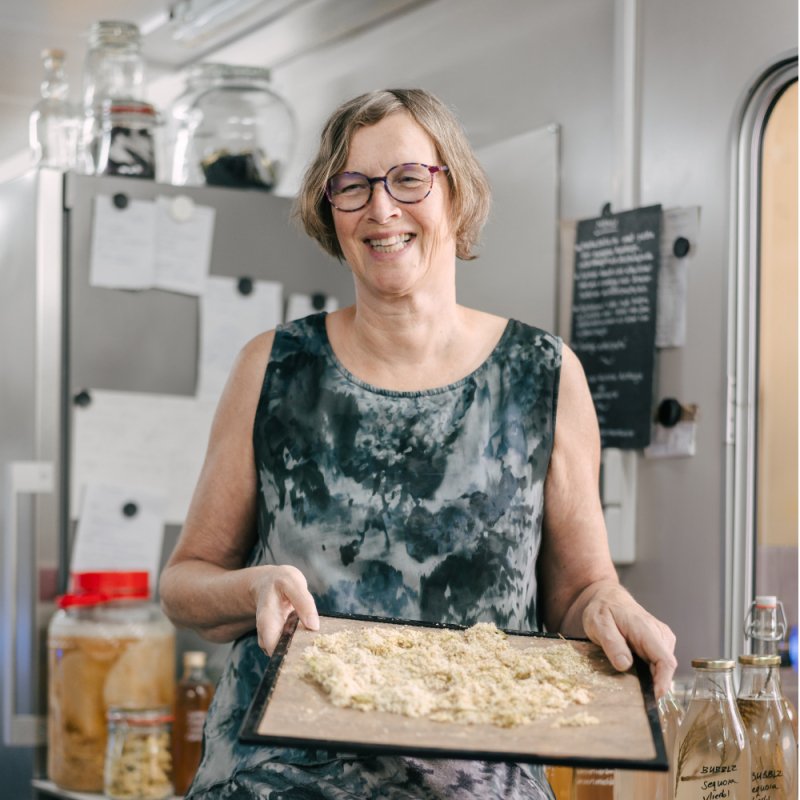
The workshops are led by the one and only Marly Bonten. She has been experimenting with processing and preservation methods for specific food forest products for over 13 years. And she’s the best person to teach you how to process food forest harvests throughout the seasons.
Of course, with a cooking workshop, we won't get away with the usual Food from the Forest lunch. The first lesson Marly will provide the entire lunch. In subsequent classes, lunch becomes part of the curriculum: Marly provides a so-called signature dish, such as an almond soup or acorn pâté, and 2-3 students are given an assignment to take home for the next lunch. Count on this taste experience to make you even more excited about food forests than you already were.
The workshops are held at Natuurgoed Ziedewij in Barendrecht and are open to anyone who already has some cooking experience, as well as to more serious cooks.
Saturday, April 17, 2027, from 10:00 a.m. to 5:00 p.m.
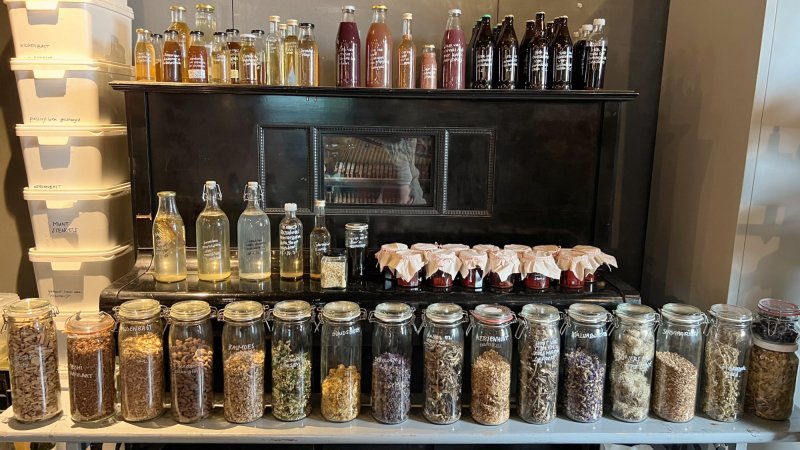
In the first processing workshop, Marly will teach you all about drying fruits, leaves, roots and flowers for such things as tea blends, weed salts, green smoothie powder, fruit leather and junk-free candy, crackers and cruesli.
The topics Marly covers are:
- What different drying techniques exist?
- How do you do that, drying?
- Which food forest crops are useful for which drying techniques?
We’ll also take a walk around the nature reserve and harvest wild herbs. Afterward, you’ll get to work making fruit leather and crackers. A package of dried food forest products prepared by Marly will be waiting for each participant (since the products we make won’t be dry yet by the time we head home).

Saturday, May 22, from 10:00 a.m. to 5:00 p.m.
Fermentation makes fruits and vegetables last longer, but it is also a wonderful way to change flavors. Did you know that 30-40% of our daily food is created by fermentation?
You will learn to ferment roots, fruits, flowers and leaves for kimchi and sauerkraut and fermented tea from the food forest in this workshop. We will also make pickles from food forest capers, licorice roots, hosta shoots and use shiitakes to make coffee
The topics Marly covers are:
- What is a ferment?
- How to make a lactofermentation (2 ways)
- Which food forest crops are useful for which fermentation technique?
- Health benefits of fermented products.
We will then make a lactofermentation, based on food forest harvests. You can bring your own leaves from the food forest, or from the wild, from which you can then make a product, but Marly will also have collected enough already.
After a delicious food forest lunch, we get to work on pickles after first a bit of theory on the subject. For example, how to make capers from various harvests, or pickles from licorice roots, hosta shoots and other food forest crops
We will compare recipes and flavor the pickle liquid.
You will go home with your own fermented and pickled products.

Saturday, June 26, from 10:00 a.m. to 5:00 p.m.
This third workshop focuses on “wild” beverages: you’ll learn how to make low-alcohol drinks using wild fermentation, as well as syrups, shrubs, and liqueurs.
The topics Marly covers are:
- A bit of history and theory about wild yeasts,
- Where can you find them?
- How can you use wild yeasts for your products?
- How do you develop your own recipes?
- How long do your products have a shelf life?
- What crop can you use for syrups and shrubs?
- What techniques are there?
- How do we sweeten our syrups?
- What flavors are suitable for this and what can we use?
- How do you use syrup in wild fermentations (and save a lot of labor time)?
- What fruits, spices etc do you choose for liqueurs?
- What alcohol do you use as a base for the liqueur?
- How do you determine the sugar content and which sugar to use?
- How does that work, sieving and bottling?
- Andne is this allowed just like that, or in other words, what about licensing and excise?
We're going to taste a variety of drinks.
Marly will take care of the harvest (you’re welcome to bring your own harvest, of course), and you’ll go home with a recipe for a drink of your choice.

Saturday, September 11, from 10:00 a.m. to 5:00 p.m.
A lot of harvest from the food forest has to do with fruit. Fruit comes in short periods of abundance so, how can you preserve it so you can enjoy that abundant harvest year round? In this fourth processing workshop we will work with this. You will learn how to process all these goodies into juice, jelly, jam, chutney, relish, sauce, and sambal.
The topics Marly covers are:
- What different preservation techniques exist?
- How do you do that, conserve?
- What do you do when? You will learn to plan a year-round work schedule.
- Which food forest crops are useful for which conservation technique?
- How do you make your own recipes?
- What about the shelf life of your products
You’ll get to work testing the recipes you’ve developed in practice, and you’ll also learn how to use a pH meter.

Saturday, October 9
In this fifth processing workshop, you’ll make cider, vinegar, and wine. What do these three beverages have in common? You’ll learn that cider can be made from more than just apples and that vinegar is a living product that can be made from a wide variety of wild forest foods.
The following theory is discussed:
- How do you make wine?
- How do you make cider?
- How do you make vinegar?
What do wine, cider and vinegar have to do with each other? And how do you keep your wine from turning into vinegar if you choose not to?
We’ll also explore which forest harvests we can use for wine, cider, or vinegar, and you’ll learn how to develop your own recipes. To do this, we’ll use calculation models for sugar and acid content. You’ll learn how to calculate the alcohol content of your beverage and how to control or adjust the fermentation process. You’ll also learn more about laws and regulations.
We conclude with a little tasting. You will go home with a live vinegar and a vinegar nut.

Saturday, November 6
In this sixth and final processing workshop, you will learn how to extract protein from plant products. After all, this is a big issue. Important for the climate, and for the livability of the planet, we all know, but how? In this day you will work with the harvest from the highest canopy of the food forest, namely the oaks, chestnuts, walnut and spruce. You'll learn to make nut flour, either as a by-product of oil pressing, or as full-fat flour. You will also learn to extract starch from licorice roots and acorns. We will make acorn flour and Marly share recipes for its application.
From the bushes we use hazelnuts and the seeds of the rose hip.
We also harvest from the herb layer and make flour from seeds of sorrel and plantain.
The topics Marly covers are:
- What is nut meal (full fat or as a by-product of oil pressing)?
- How do you process acorns and chestnuts into flour?
- How to make flour from the seeds of plantain, sorrel and, rose hip
- Which food forest crops are useful for which technique?
- How to make superfood powders (as a by-product of de-sapering) and use the (dusting) flour of e.g. pine and cattail and dried and ground leaves and more.
Today, we’ll get started with oil pressing and extraction, and we’ll learn which food forest crops are suitable for each technique and why. And, how do you use different techniques effectively?
You'll learn even more about the health benefits of the products, how to create your own recipes using flour from the food forest, and how to combine different products.
You will go home with a lot of knowledge and, of course, another homemade product.
Teachers
Practical information
All course days will be held at Natuurgoed Ziedewij in Barendrecht. The Natuurgoed is still under construction, but has a small orchard, a 2-hectare forest and 2 hectares of strip cultivation. The course location is a monumental, thatched farmhouse, partially restored with a large kitchen. On-site parking is available. You can also travel by public transport to Barendrecht station, and then cycle 3 kilometers, with OV bike for example. The address is Noldijk 126 2991VL Barendrecht.
All days start at 10 a.m. and last until 5 p.m.
The theoretical parts of all workshop days are recorded. Did you sign up but can't attend, or were you at the back of the group? You can always watch the lesson back.
We offer you a digital course environment where you can find the course materials and all recordings, and where you can easily ask questions among yourselves and/or make carpool arrangements.
The cost is €200 (excluding VAT) per day if you attend for one day. We charge €190 if you attend for two days, €180 if you attend for three days, and €175 if you book more days. The cost includes materials (jars, bottles, and wild food harvests to be processed) and a delicious lunch.
A maximum of 15 people can participate in the days of this module. So don't wait too long to register.
We deliver this workshop according to our terms of delivery. These are simple and clear, so please feel free to read them.
If you cannot pay the workshop fee in one lump sum, or are with an organization that works with billing, please feel free to contact us.